

Area 2: Degradation Mechanisms
This area investigates how battery systems and key components degrade over lifetime, transforming this understanding into safer and more reliable battery technologies. Looking beyond battery lifetime and operational strategies, the research focus includes the aging behavior of critical system components such as interface materials (e.g. compression pads, thermal interface materials) and safety-relevant components (e.g. pyro fuses, sensors). By translating degradation understanding into advanced models and testing strategies, Area 2 supports the integration of battery lifetime considerations into system design, safety assessment, functional safety concepts, and optimized operation strategies.
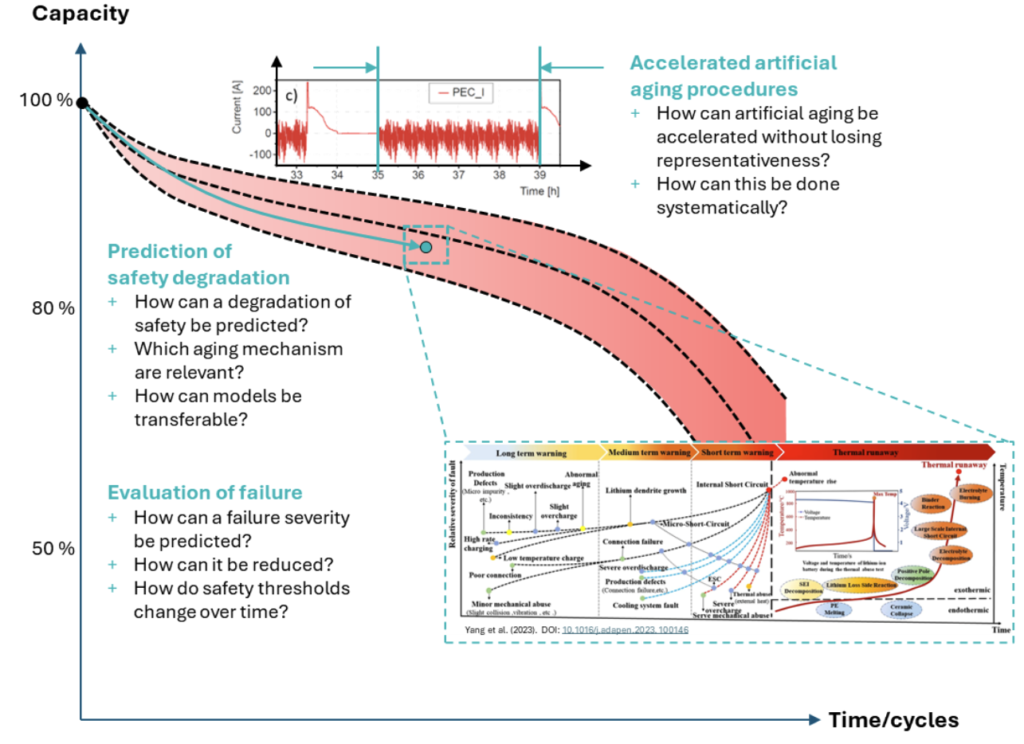
Prediction of safety degradation
Novel degradation models will link battery aging with changes in safety-critical properties such as mechanical stiffness, thermal runaway onset temperature, and maximum intrusion depth. By identifying relevant aging mechanisms and applying physics-based modeling approaches, these models aim to enable reliable predictions and allow for a transferability between different battery systems.
Accelerated artificial aging procedures
Representative and accelerated aging strategies will be developed using advanced degradation models to reduce costly and time-intensive testing. These strategies systematically replicate real operating conditions while accounting for crucial factors such as battery cell inhomogeneity and relaxation effects that will be investigated in detail to guarantee representativeness. Similar approaches will be used to design procedures for other components like interface materials.
Evaluation of failure
Aging modes and degradation mechanisms that evolve on different time scales will be linked with failure severity and safety thresholds (e.g., maximum intrusion depth, onset temperature for thermal runaway). Advanced post-mortem analyses and non-destructive techniques such as electrochemical impedance spectroscopy, CT scanning, or electrical characterization are used to track changes over time. These insights are integrated into degradation models to predict how safety margins change throughout a battery’s lifetime.
Area 1
Prediction and Optimization
Area 1 focuses on developing advanced models and simulation methods to predict, optimize, and improve the safety and performance of battery cells and systems. By combining multi-physics modeling, virtual development, and research on next-generation battery technologies, it reduces testing effort and accelerates reliable battery design across the entire lifecycle.
Scale-up and Virtual Development
Component-Based Cell Behavior Prediction
New Battery Technologies
Multi-Physical Characterization and Modeling
Area 3
Monitoring and Failure Prognosis
Area 3 develops diagnostic strategies and physics-based as well as data-driven models to monitor battery state and define a State of Safety (SOS), enabling the prediction of safety evolution and Remaining Safe Useful Life (RSUL) in order to support early risk detection, predictive maintenance, adaptive operation, and optimized second-life deployment.
Monitoring and Failure Prognosis
Battery State Monitoring: Quantifying Safety
Failure Prognosis: Predictive and Adaptive Operation
